
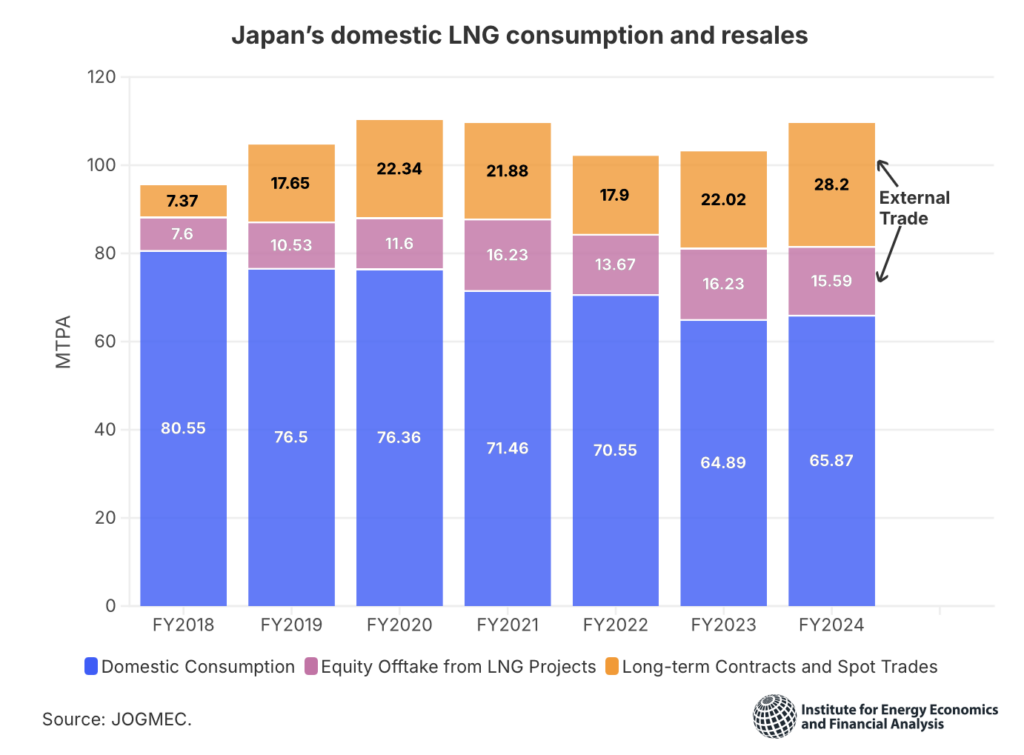
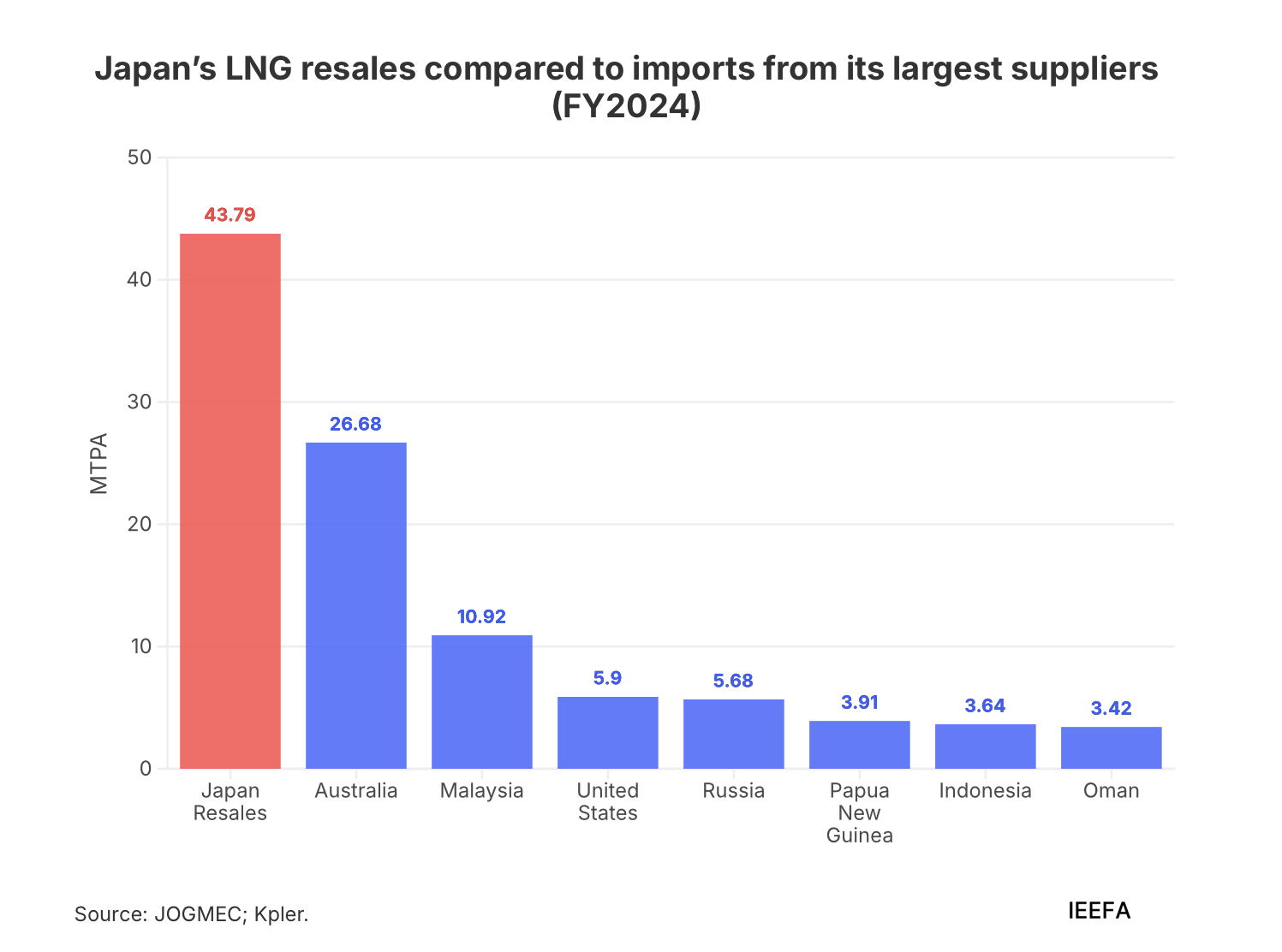
Japan LNG resales reached record levels in FY2024 as declining domestic consumption pushed Japanese energy firms to sell a growing share of contracted cargoes into overseas markets, according to recent analysis by the Institute for Energy Economics and Financial Analysis (IEEFA).
Japan’s role in the global LNG market is undergoing a structural shift, with utilities and trading houses increasingly acting as international resellers rather than purely domestic consumers. According to the analysis, Japanese companies now resell a substantial share of the LNG they procure, driven by a steady decline in domestic demand since the late 2010s.
Nuclear restarts, energy efficiency improvements and the expansion of renewable generation are expected to further reduce Japan’s LNG consumption over the coming years, reinforcing the need to redirect surplus volumes abroad.
At the same time, Japanese firms continue to sign long-term supply contracts, particularly with U.S. producers, often featuring destination flexibility that allows cargoes to be diverted to third countries.
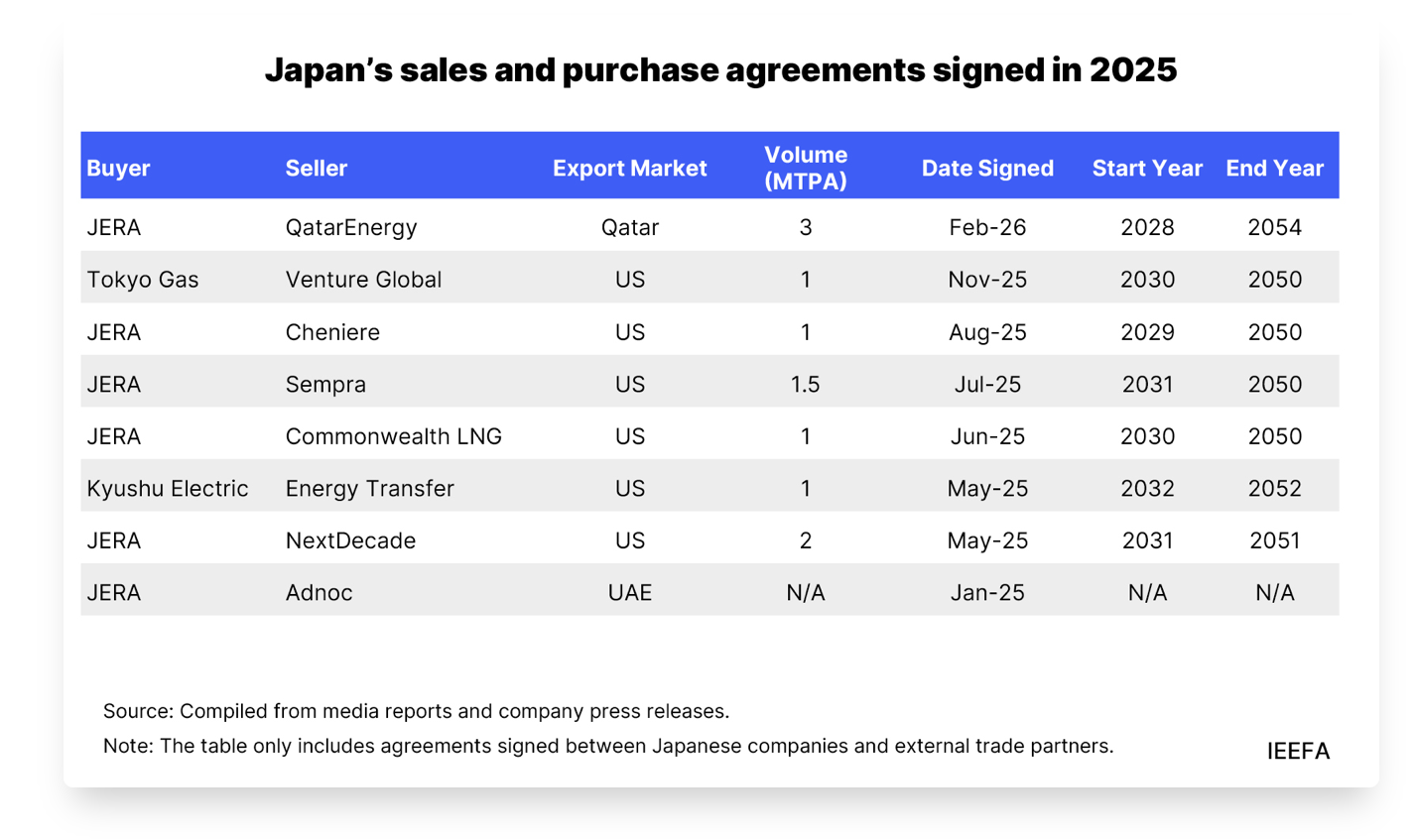
This shift toward more flexible contracting structures has enabled companies to pursue arbitrage opportunities and build long-term customer relationships across Asia and other emerging markets. Investments in downstream infrastructure in South and Southeast Asia have also supported the development of new demand centres for resold cargoes.
However, the strategy carries risks. Growing global LNG supply and expectations of market oversaturation could compress margins for resellers, particularly as feedgas costs and competition increase. Japanese companies may therefore face financial exposure if prices weaken while contractual purchase obligations remain high.
The findings suggest that Japan’s evolution into a major LNG trading hub could enhance market liquidity but also amplify volatility as more cargoes are redirected across regions in response to shifting demand patterns.
Source: Institute for Energy Economics and Financial Analysis (IEEFA)
FURTHER RESOURCES