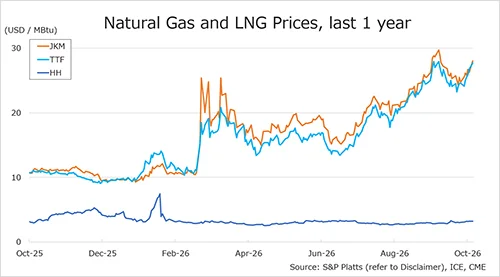
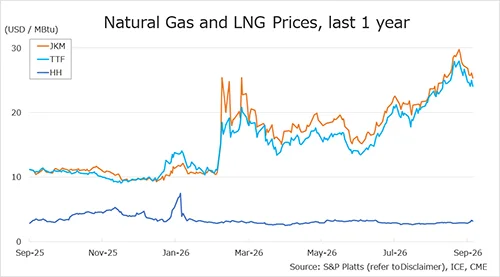
Natural gas prices declined sharply in Asia and Europe last week as expectations of easing geopolitical tensions in the Middle East weighed on LNG markets. JKM and TTF fell amid hopes of a diplomatic resolution, while Henry Hub edged higher on stronger LNG feedgas demand and a smaller-than-expected increase in U.S. gas inventories.
Asia – JKM
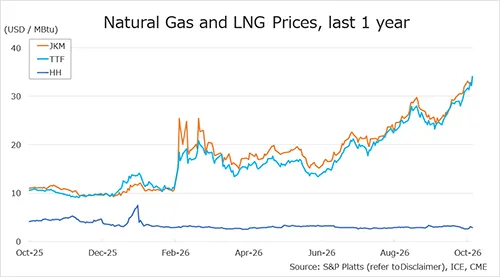
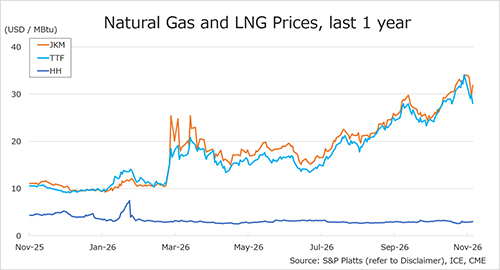
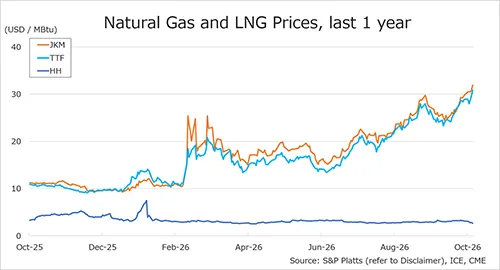
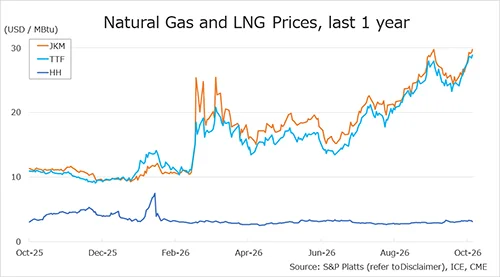
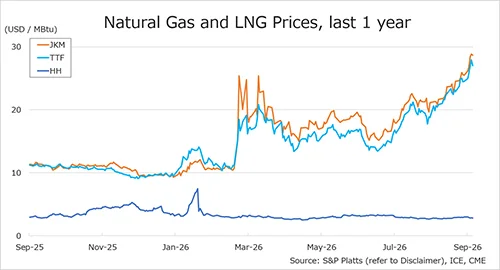
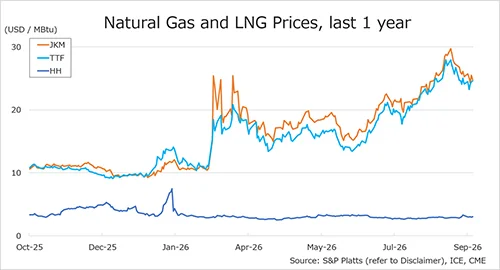
The Northeast Asian assessed spot LNG price JKM (December delivery) for last week (2–6 November) fell to low-USD 32s/MBtu on 6 November from low-USD 34s/MBtu the previous weekend (30 October).
At the beginning of the week, JKM fell to mid-USD 33s/MBtu on 3 November, as signs of progress in diplomatic talks between the U.S. and Iran raised expectations for an end to the war in the Middle East.
On 4 November, it continued to fall sharply to mid-USD 31s/MBtu as concerns over geopolitical risks in the Middle East eased following the results of the U.S. midterm elections.
It fell further to mid-USD 29s/MBtu on 5 November on expectations for an early diplomatic resolution.
However, on 6 November, uncertainty over the situation in the Middle East remained, while market participants became more cautious about the prospect of a recovery in supply. With supply remaining tight, JKM rebounded to the high-USD 31s/MBtu by the end of the week.
Buying interest from Asian end-users remained weak throughout the week. Although the price temporarily fell below USD 30/MBtu, cargoes were still viewed as expensive and trading activity remained subdued.
METI announced on 4 November that Japan’s LNG inventories for power generation as of 1 November stood at 1.92 million tonnes, down 0.23 million tonnes from the previous week.
Europe – TTF
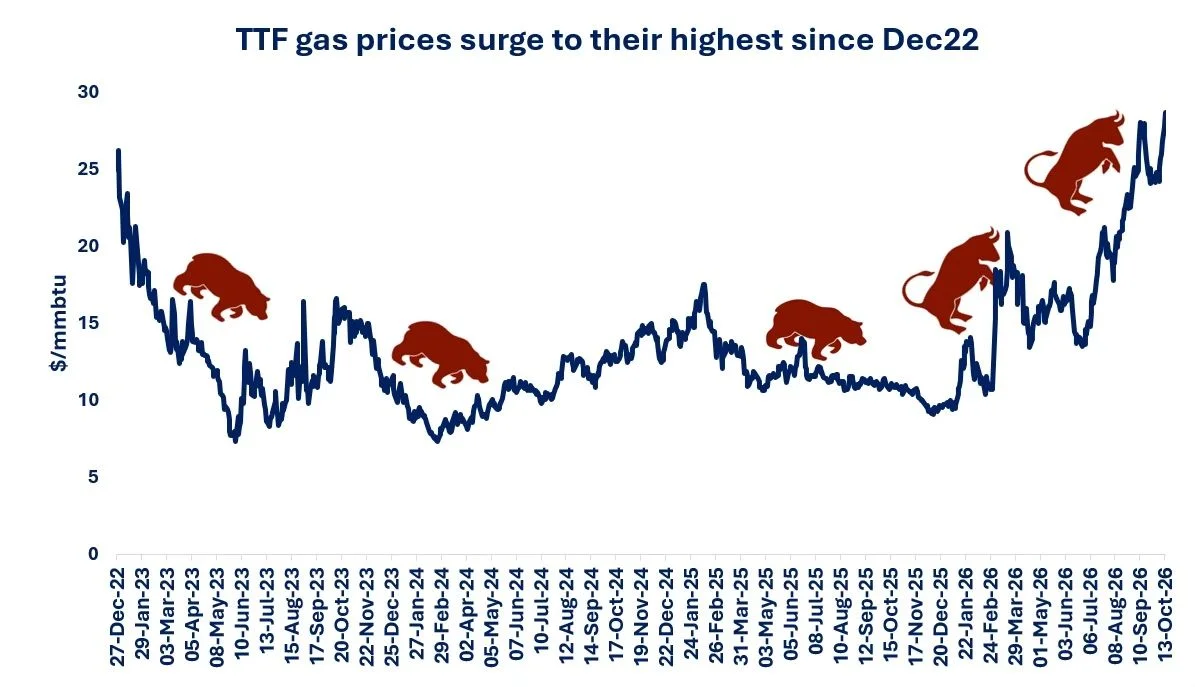
The European gas price TTF for last week (2–6 November, December delivery) fell to USD 28.0/MBtu on 6 November from USD 34.0/MBtu the previous weekend (30 October).
At the beginning of the week, President Trump took a cautious stance toward resuming military strikes against Iran, easing geopolitical risks and leading to a sharp decline of nearly USD 3/MBtu on 2 November.
TTF continued to fall as the results of the U.S. midterm elections raised expectations for an early end to the war in the Middle East, reaching USD 29.1/MBtu on 4 November.
TTF temporarily rose on 5 November amid renewed uncertainty over the situation in the Middle East, but resumed its decline the following day.
A sharp increase in regasification volumes in Europe also weighed on the market, with TTF ending the week at USD 28.0/MBtu, down around 18% from the previous weekend.
According to AGSI+, EU-wide underground gas storage was 73.0% on 6 November, down from 74.7% the previous weekend, down 12.6% from the same period last year, and down 18.6% from the five-year average.
United States – Henry Hub
The U.S. gas price HH for last week (2–6 November, December delivery) rose to USD 3.0/MBtu on 6 November from USD 2.9/MBtu the previous weekend (30 October).
On 2 November, HH fell below USD 2.9/MBtu due to lower demand amid warm weather, but moved back above USD 2.9/MBtu on 3 November as feedgas demand from LNG liquefaction facilities increased, supported by steady demand from Europe.
It continued to rise on expectations that LNG demand would persist and after EIA data released on 5 November showed that the increase in U.S. gas inventories was smaller than market expectations, reaching USD 3.0/MBtu on 6 November.
The EIA Weekly Natural Gas Storage Report released on 5 November showed U.S. natural gas inventories as of 30 October at 3,801 Bcf, up 77 Bcf from the previous week, down 2.8% from the same period last year, and 1.4% above the five-year average.
Source: JOGMEC
Updated: 9 November 2026