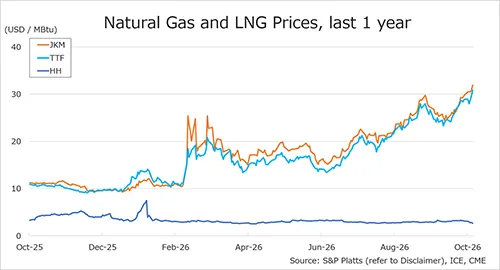
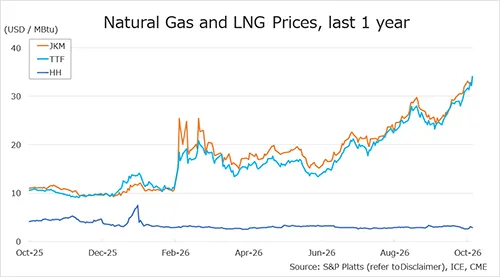
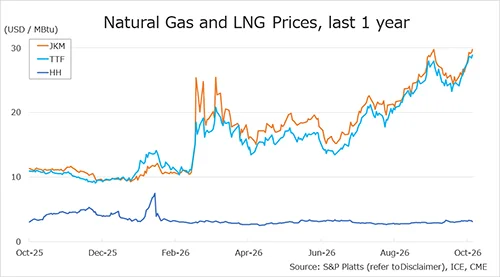
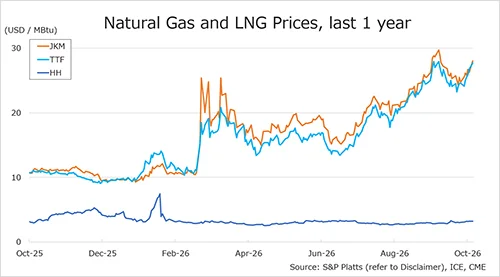
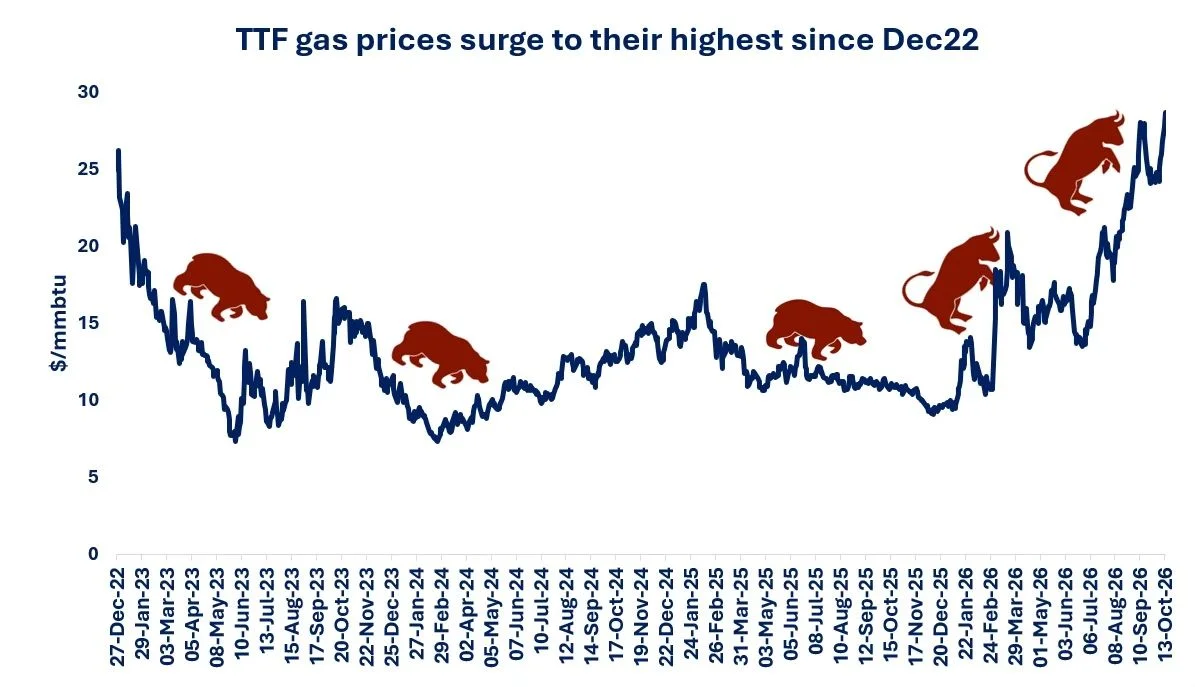
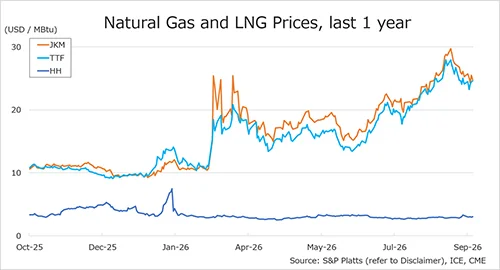
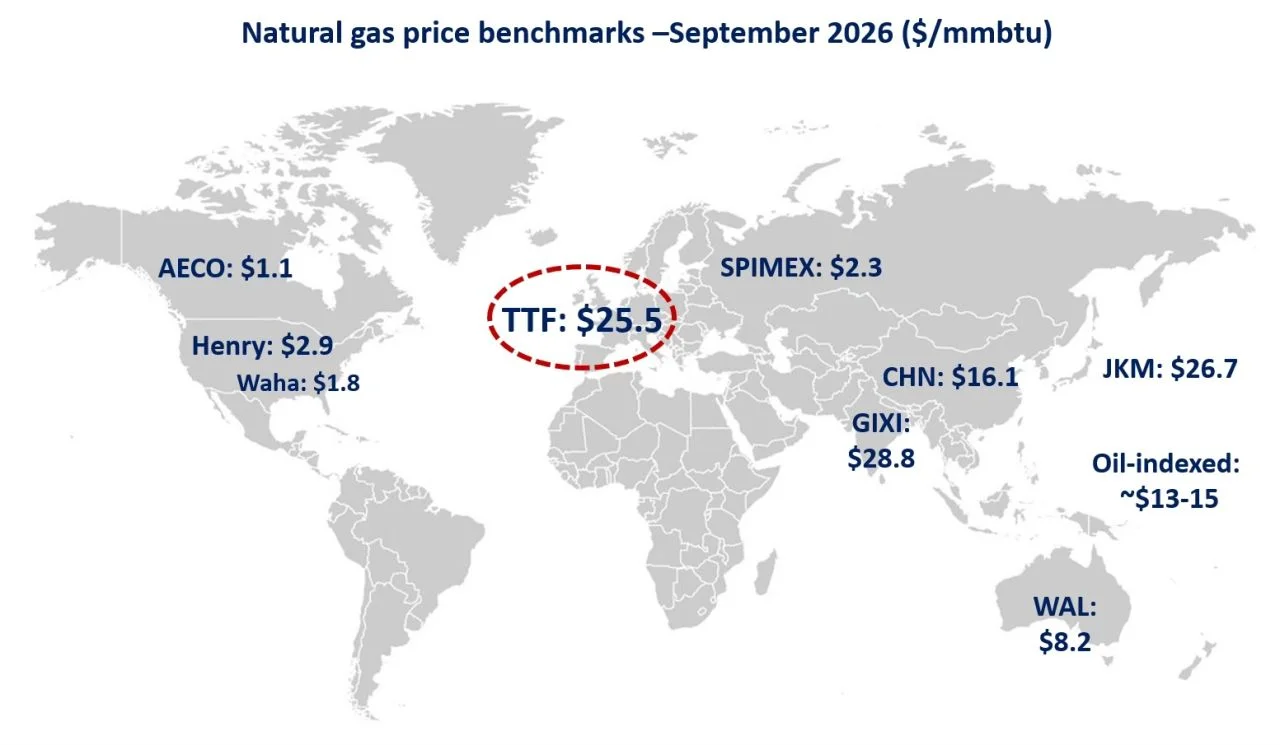
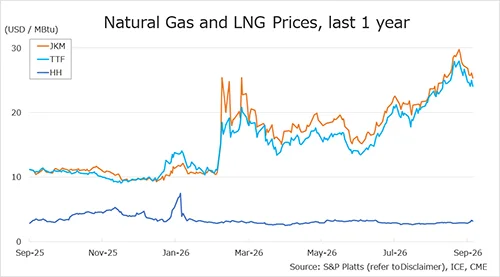
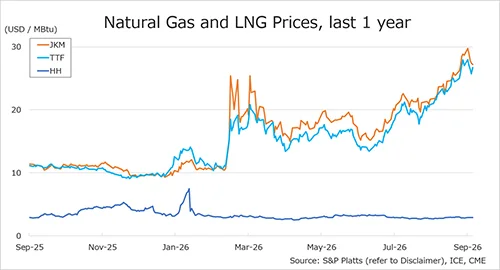
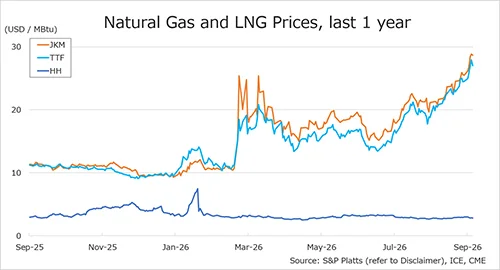
Natural gas prices rose across Asia, Europe and the United States last week, supported by stronger winter demand expectations and renewed supply concerns. JKM and TTF climbed amid colder weather forecasts and Middle East disruptions, while Henry Hub gained following the rollover to December delivery despite mild U.S. weather expectations.
Asia – JKM
The Northeast Asian assessed spot LNG price JKM (December delivery) for last week (26–30 October) rose to low-USD 34s/MBtu on 30 October from high-USD 31s/MBtu the previous weekend (23 October).
At the beginning of the week, JKM rose to low-USD 33s/MBtu on 26 October, driven by rising European gas prices due to falling temperatures and low underground gas storage levels in Europe.
It then declined due to weak spot demand, particularly from Northeast Asian buyers, amid high prices, as well as the return of some cargoes to the market that had been affected by disruptions around the Strait of Hormuz.
Although JKM rose slightly on 28 October due to falling temperatures in Northeast Asia, it continued to decline to mid-USD 32s/MBtu on 29 October.
Then it rebounded to low-USD 34s/MBtu on 30 October due to rising winter demand and renewed concerns over supply risks from the Middle East.
METI announced on 28 October that Japan’s LNG inventories for power generation as of 25 October stood at 2.15 million tonnes, down 0.38 million tonnes from the previous week.
Europe – TTF
The European gas price TTF for last week (26–30 October) rose to USD 34.0/MBtu on 30 October (December delivery) from USD 30.8/MBtu the previous weekend (23 October, November delivery).
At the beginning of the week, TTF rose to USD 31.7/MBtu on 26 October due to expectations of increased gas-fired power generation following a decline in wind power generation and unplanned outages at Norwegian gas production facilities.
Although it fell slightly to USD 31.4/MBtu on 27 October due to increasing LNG arrivals across Europe, it resumed its upward trend, reaching USD 32.9/MBtu on 28 October, driven by forecasts of falling temperatures across Europe, concerns over gas supplies in next winter, and supply uncertainties arising from the shutdown of all trains at Freeport LNG in the U.S. and shipping disruptions in the Middle East.
On 29 October, it fell to USD 32.2/MBtu as increased LNG imports and pipeline gas supplies from Norway outweighed these concerns.
However, it rose again to USD 34.0/MBtu on 30 October, when the contract rolled over to December delivery, due to growing concerns over the situation in the Middle East and the extension of an unplanned outage at Oseberg gas field in Norway.
According to AGSI+, EU-wide underground gas storage was 74.7% on 30 October, almost unchanged from the previous weekend. It rose to nearly 75% on 27 October before beginning to decline.
Gas inventories were down 10.5% from the same period last year and down 16.8% from the five-year average.
United States – Henry Hub
The U.S. gas price HH for last week (26–30 October) rose to USD 2.9/MBtu on 30 October (December delivery) from USD 2.6/MBtu the previous weekend (23 October, November delivery).
At the beginning of the week, HH fell to USD 2.6/MBtu on 26 October due to forecasts of mild weather continuing into early November, but rebounded to USD 2.7/MBtu on 27 October due to a market correction following the previous price declines.
On 28 October, when the contract rolled over to December delivery, HH rose to USD 3.0/MBtu due to increased expectations of winter demand compared with the previous contract month, as well as rising feedgas demand for LNG exports.
However, the impact of winter demand this year is expected to be more limited than usual, as a warmer-than-average winter in the Lower 48 is forecast this year.
HH subsequently declined to USD 2.9/MBtu on 30 October due to a larger-than-expected increase in gas inventories reported in the latest EIA storage data, a recovery in domestic gas production, and weak heating demand amid forecasts of mild weather.
The EIA Weekly Natural Gas Storage Report released on 29 October showed U.S. natural gas inventories as of 23 October at 3,724 Bcf, up 80 Bcf from the previous week, down 3.8% from the same period last year, and 1.0% above the five-year average.
Source: JOGMEC
Updated: 2 November 2026