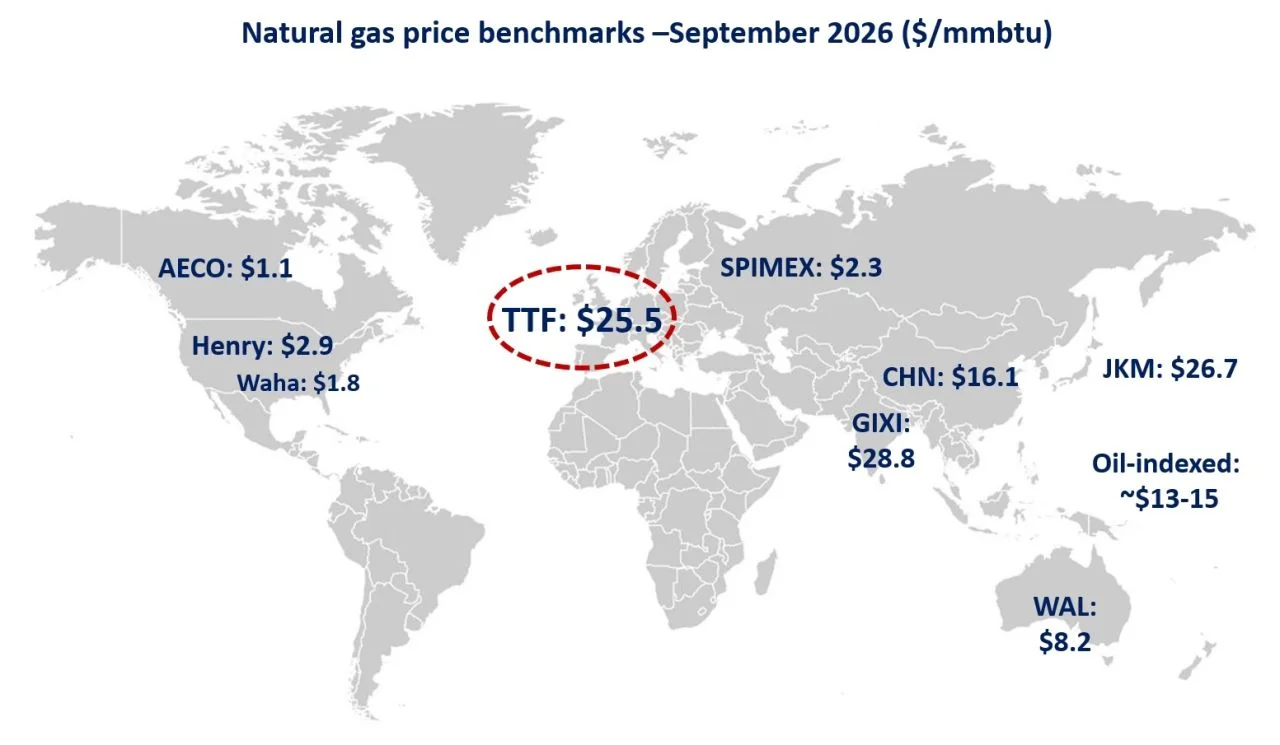
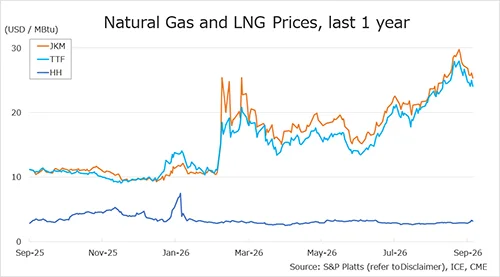
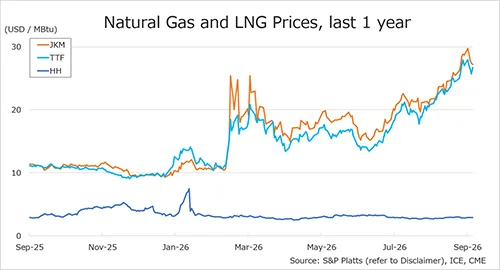
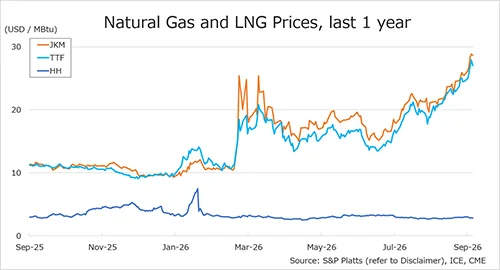
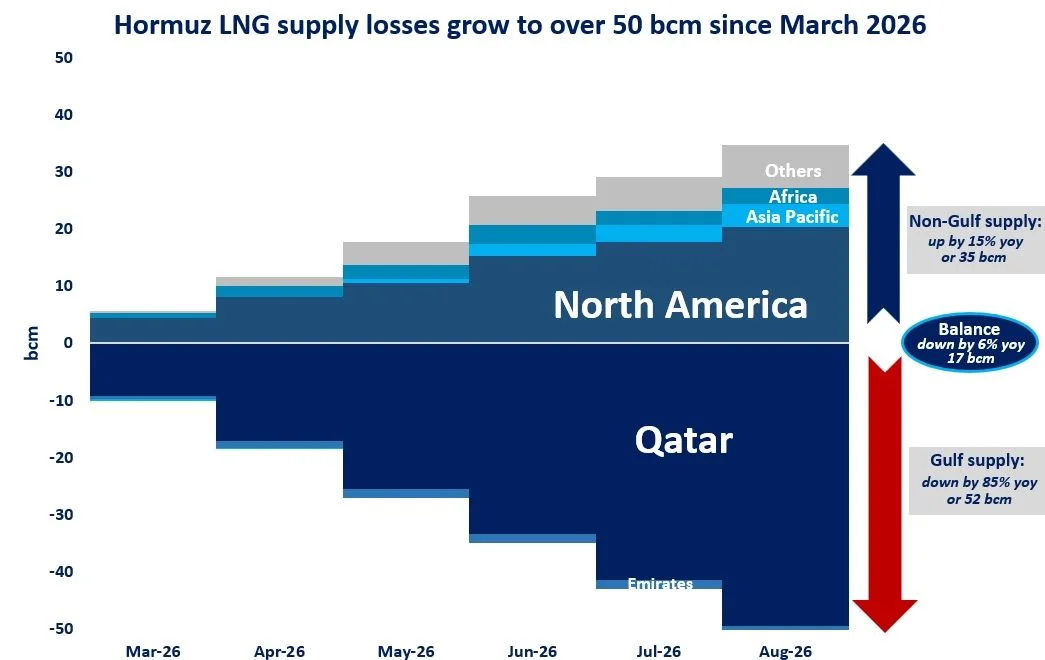
Natural gas prices increased across Asia, Europe and the United States last week, supported by geopolitical tensions in the Middle East, colder European weather and U.S. supply disruptions. JKM and TTF climbed amid renewed LNG supply concerns, while Henry Hub gained on stronger heating demand and hurricane-related production outages.
Asia – JKM
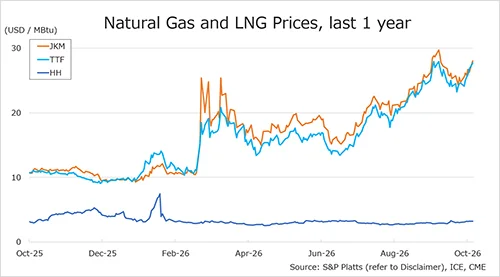
The Northeast Asian assessed spot LNG price JKM for last week (5 October – 9 October, November delivery) rose from the high-USD 24s/MBtu at the end of the previous week (2 October) to the low-USD 26s/MBtu on 9 October.
At the beginning of the week, prices rose amid heightened geopolitical risks in the Middle East and a narrowing price spread with European gas prices, reaching the low-USD 26s/MBtu on 6 October.
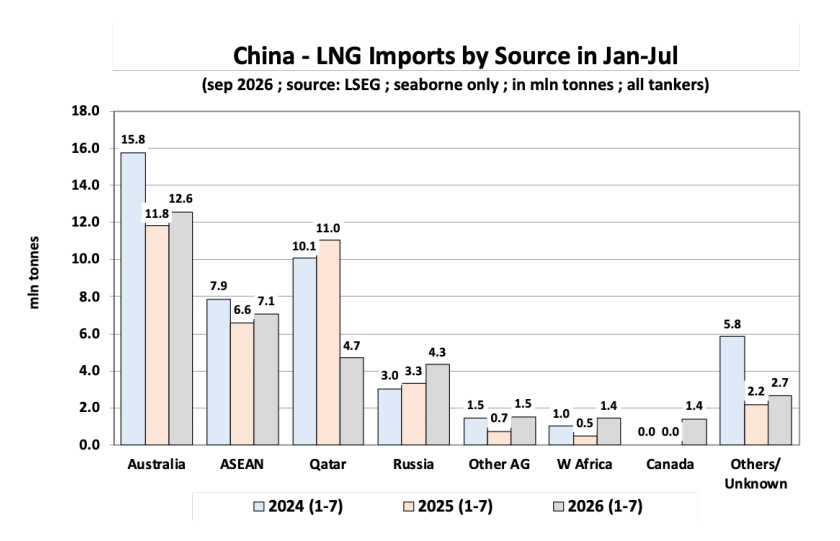
On 7 October, prices fell to the high-USD 25s/MBtu as concerns over near-term supply shortages eased following improved LNG loadings from Qatar, while demand remained weak, particularly in South Asia.
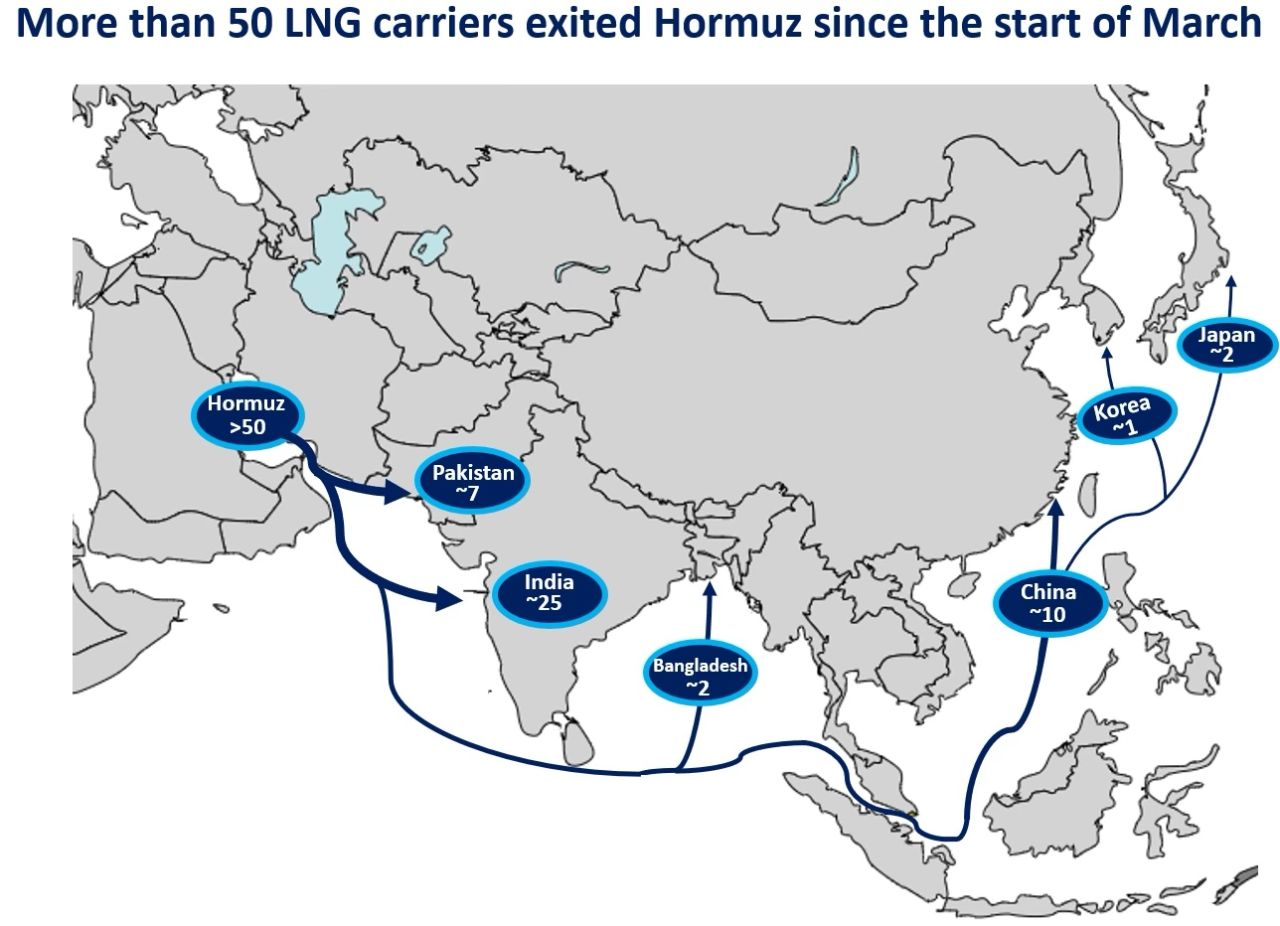
However, prices rose to the high-USD 26s/MBtu on 8 October as an increase in attacks on vessels in the Strait of Hormuz renewed concerns over supply risks.
On 9 October, prices fell back to the low-USD 26s/MBtu as buying interest in Northeast Asia remained limited and prompt cargo availability in South Asia improved, although persistent geopolitical risks continued to support prices.
METI announced on 7 October that Japan’s LNG inventories for power generation as of 4 October stood at 2.58 million tonnes, up 0.17 million tonnes from the previous week.
Europe – TTF
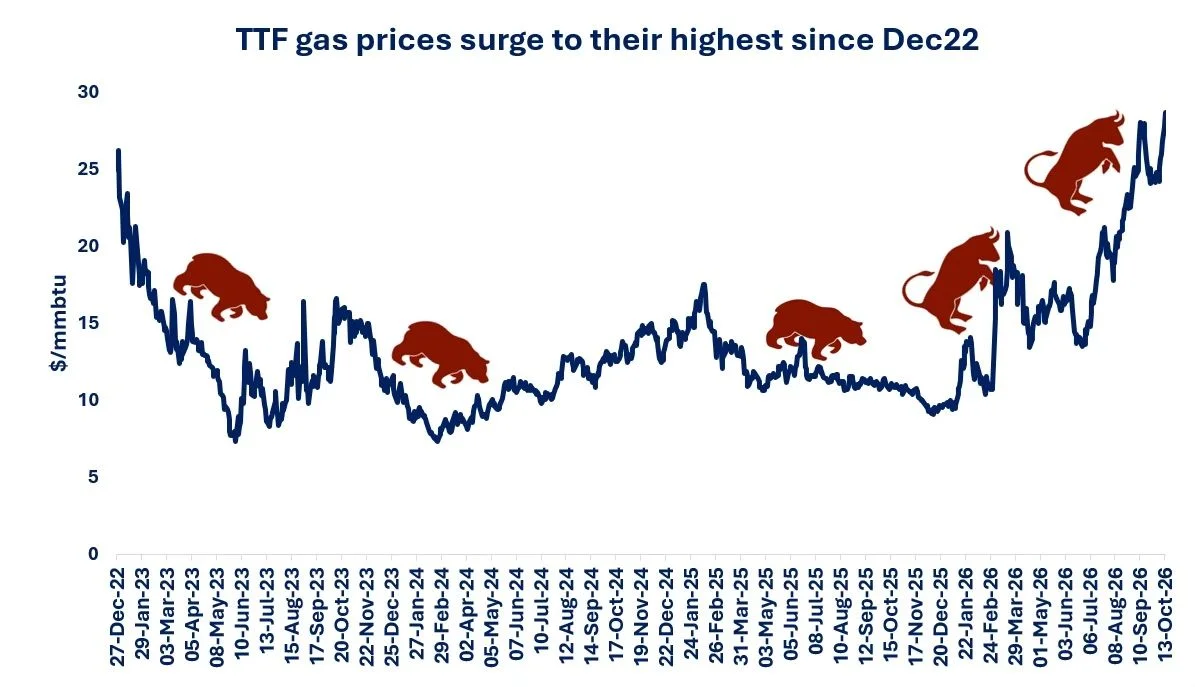
The European gas price TTF for last week (5 October – 9 October, November delivery) rose from USD 24.6/MBtu at the end of the previous week (2 October) to USD 26.7/MBtu on 9 October.
At the beginning of the week, prices fell to USD 24.1/MBtu on 5 October amid increased pipeline gas supplies from Norway and forecasts for warmer temperatures.
However, prices rose to USD 25.0/MBtu on 6 October following tanker attacks in the Strait of Hormuz and forecasts for lower temperatures.
Prices continued to rise amid colder temperatures across Europe and production constraints at Norway’s Dvalin and Heidrun gas fields, reaching USD 25.6/MBtu on 7 October.
On 9 October, prices rose further to USD 26.7/MBtu as the bullish tone at the prompt end of the curve persisted and colder temperatures were forecast toward the weekend.
According to AGSI+, EU-wide underground gas storage was 73.5% on 9 October, up from 72.2% the previous weekend, down 12% from the same period last year, and 16.9% below the five-year average.
United States – Henry Hub
The U.S. gas price HH for last week (5 October – 9 October, November delivery) rose from USD 3.0/MBtu at the end of the previous week (2 October) to USD 3.2/MBtu on 9 October.
At the beginning of the week, prices rose as cooling demand remained in the western U.S., while heating demand emerged around the Great Lakes and in the Northeast.
Prices remained firm thereafter on expectations of increased heating demand, rising to USD 3.3/MBtu on 7 October amid concerns over Gulf Coast supply due to Hurricane Isaias and expectations for a smaller-than-anticipated increase in gas inventories.
On 8 October, prices fell to USD 3.2/MBtu after the EIA reported a larger-than-expected increase in U.S. gas inventories.
However, prices rose again on 9 October after 59% of natural gas production in the Gulf of Mexico was shut in due to Hurricane Isaias.
The EIA Weekly Natural Gas Storage Report released on 8 October showed U.S. natural gas inventories as of 2 October at 3,500 Bcf, up 85 Bcf from the previous week, down 3.6% from the same period last year, and up 2.0% from the five-year average.
Source: JOGMEC
Updated: 13 October 2026