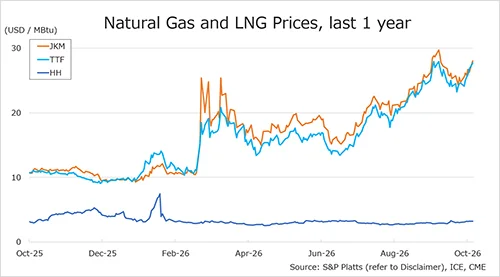
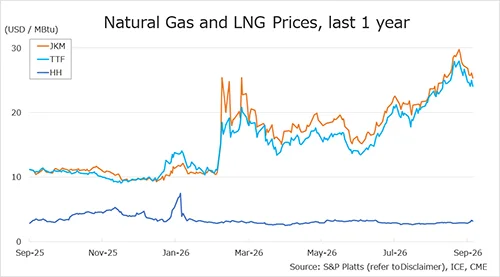
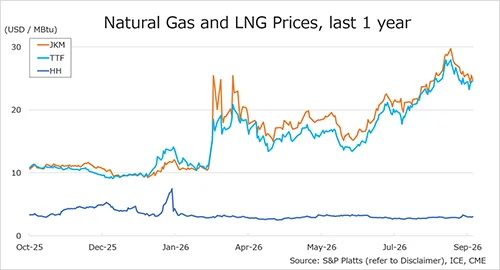
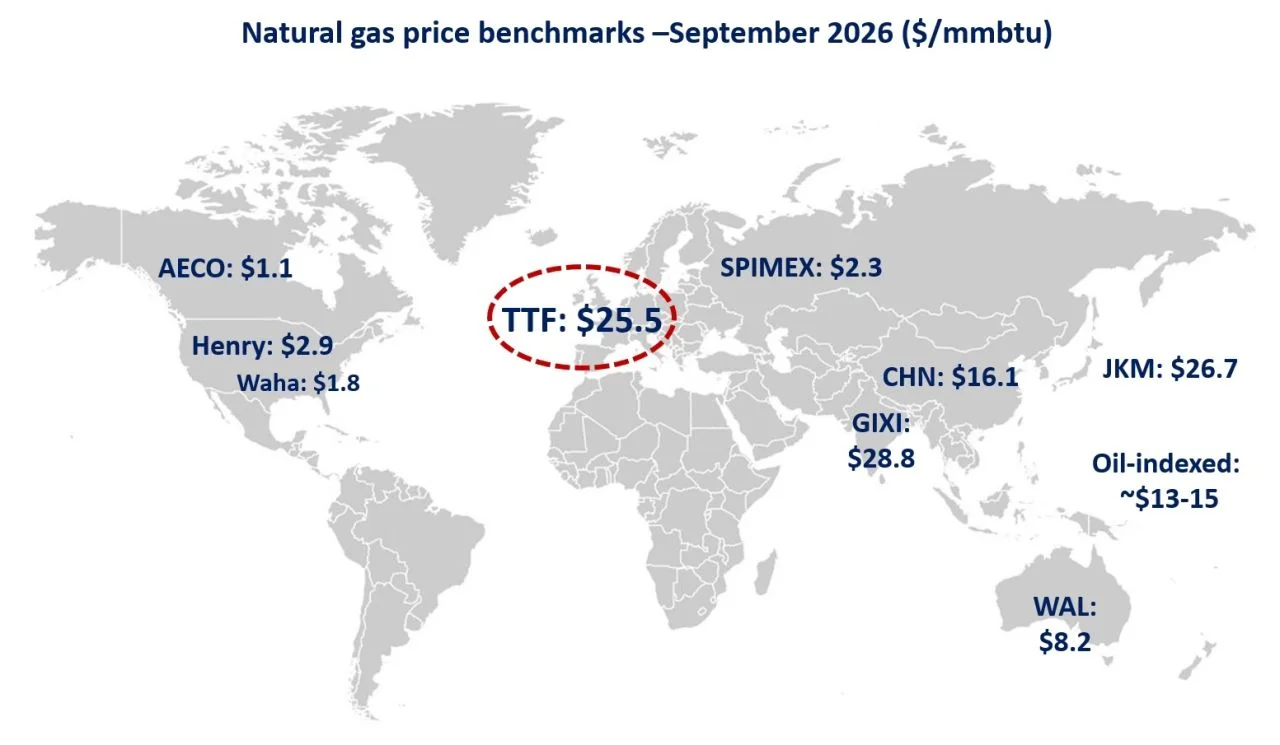
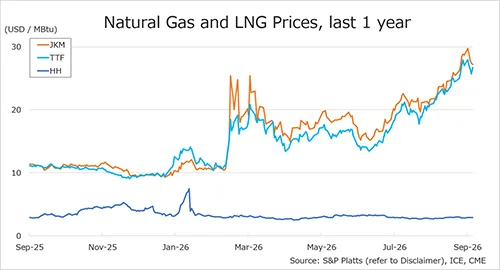
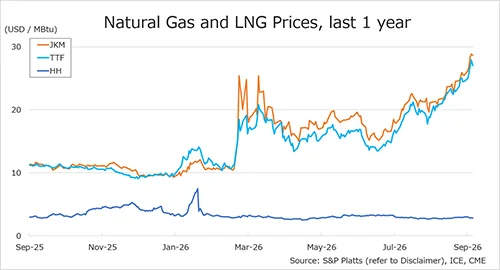
Natural gas prices fell in Asia and Europe last week as geopolitical risk premiums eased and winter procurement reduced near-term buying needs. JKM and TTF declined, while Henry Hub rose on late-summer heat, lower production and a relatively small storage build.
Asia – JKM
The Northeast Asian assessed spot LNG price JKM for last week (21–25 September, November delivery) fell to low-USD 25s/MBtu on 25 September from low-USD 27s/MBtu the previous weekend (18 September).
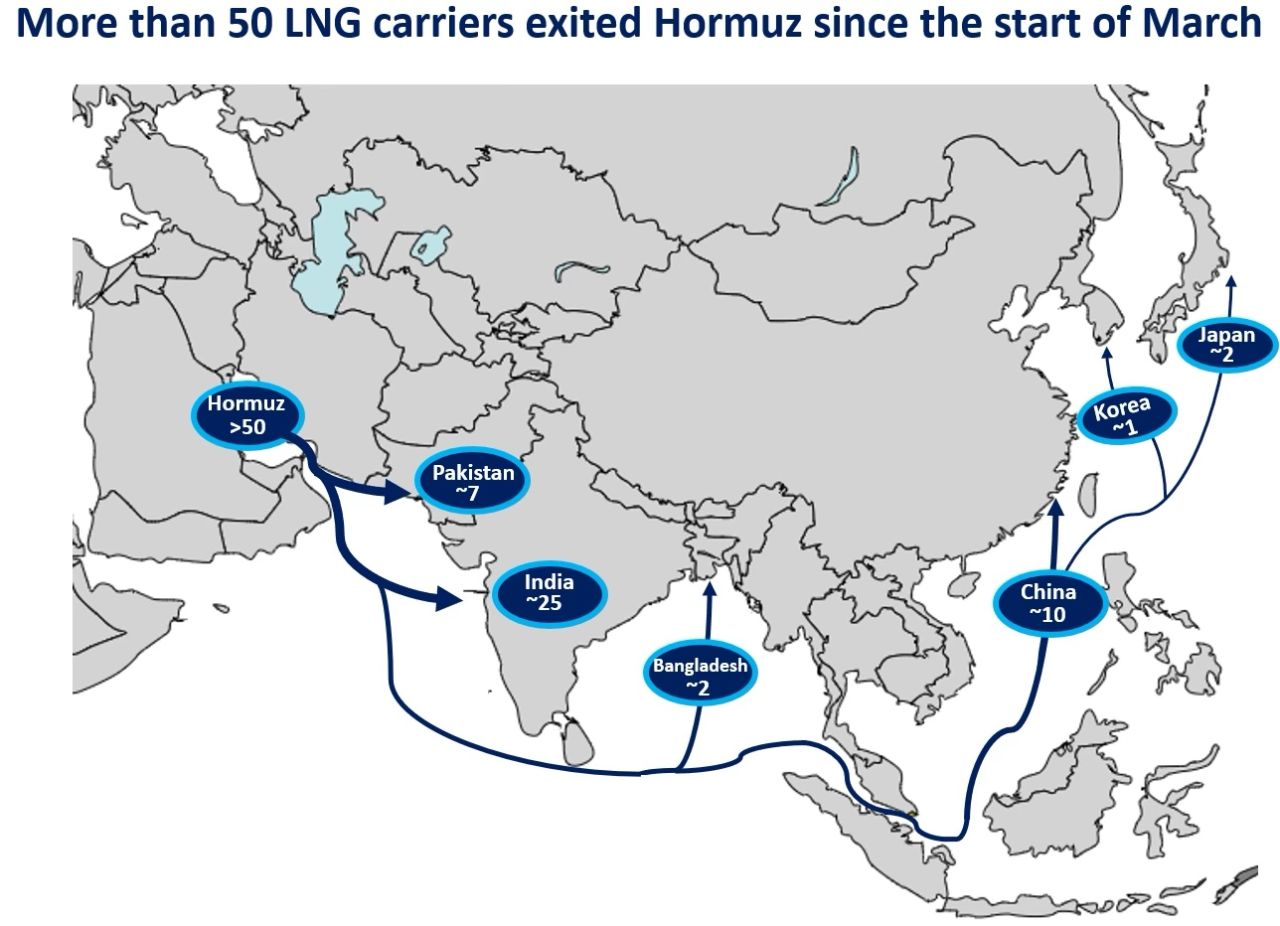
In the first half of the week, JKM continued to decline, falling to high-USD 25s/MBtu on 23 September due to a decline in the geopolitical risk premium on expectations of easing tensions in the Middle East following the passage of LNG tankers through the Strait of Hormuz and continued U.S.-Iran dialogue, as well as expectations of limited spot demand in Northeast Asia as buyers seem to have already made progress in procuring supplies for winter demand.
It then rose to low-USD 26s/MBtu on 24 September due to growing uncertainty over progress in U.S.-Iran talks and supply concerns as the arbitrage for U.S. LNG to Asia remained uneconomical.
However, JKM fell to low-USD 25s/MBtu on 25 September following reports that Iran had proposed reopening the Strait of Hormuz under certain conditions.
Europe – TTF
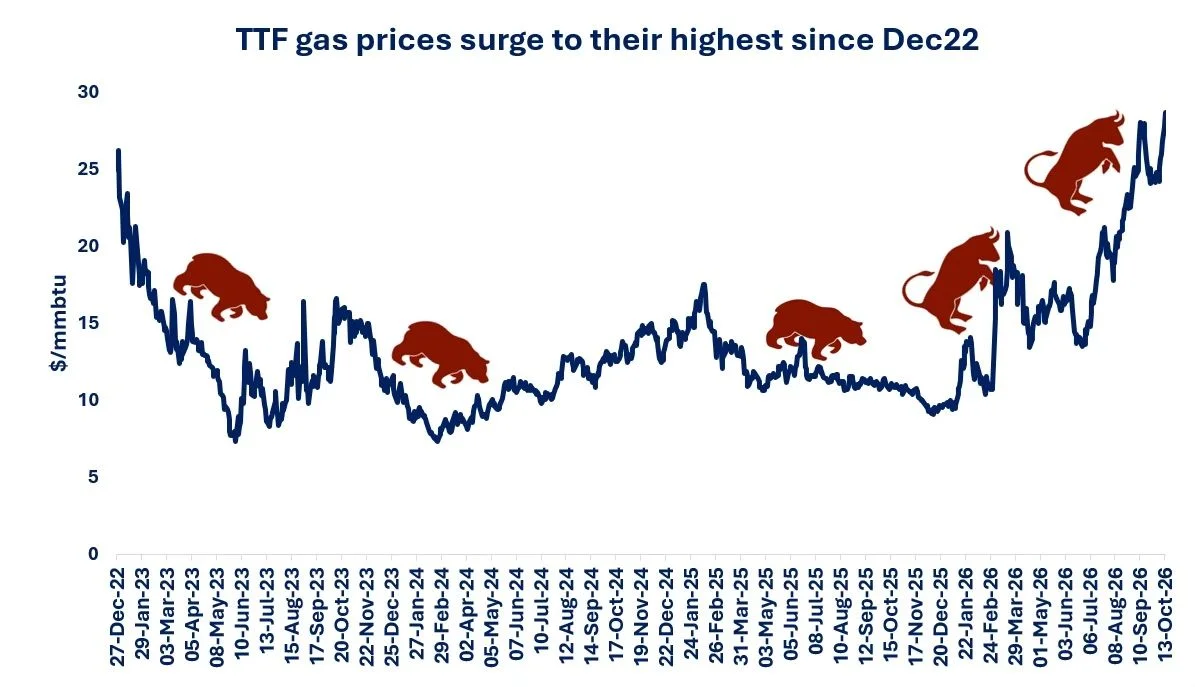
The European gas price TTF for last week (21–25 September, October delivery) fell to USD 24.1/MBtu on 25 September from USD 26.7/MBtu the previous weekend (18 September).
TTF continued to decline sharply at the beginning of the week due to forecasts of warmer weather and expectations of easing tensions in the Middle East on progress in U.S.-Iran talks, falling to USD 24.1/MBtu on 23 September.
It then rose to USD 25.0/MBtu on 24 September due to reduced gas supplies following the start of large-scale planned maintenance at Norwegian gas supply infrastructure since the previous day and an unplanned outage at another gas production facility in the country.
However, TTF fell again to USD 24.1/MBtu on 25 September due to a decline in the geopolitical risk premium on expectations of progress in U.S.-Iran talks and forecasts of above-normal temperatures in Europe.
According to AGSI+, EU-wide underground gas storage was 70.6% on 25 September, up from 69.31% the previous weekend, down 14.6% from the same period last year and down 18.3% from the five-year average.
United States – Henry Hub
The U.S. gas price HH for last week (21–25 September, October delivery) rose to USD 3.2/MBtu on 25 September from USD 2.9/MBtu the previous weekend (18 September).
HH fell to high-USD 2s/MBtu on 21 September due to a decline in futures prices on a bearish outlook for winter demand.
It then turned upward due to forecasts of higher temperatures across the south-central U.S. and expectations of increased gas demand due to late-summer heat.
On 24 September, HH rose to USD 3.3/MBtu following the EIA Weekly Natural Gas Storage Report released on the same day, which showed a seasonally low storage build, as well as a decline in gas production.
It then fell slightly to USD 3.2/MBtu on 25 September due to profit-taking following the previous day’s price increase.
The EIA Weekly Natural Gas Storage Report released on 24 September showed U.S. natural gas inventories as of 18 September at 3,351 Bcf, up 53 Bcf from the previous week, down 4.2% from the same period last year and 2.9% above the five-year average.
Source: JOGMEC
Updated: 28 September 2026