Australian LNG has long been regarded as one of the industry’s greatest success stories, transforming the country into one of the world’s leading LNG exporters through a wave of major projects commissioned between 2015 and 2019. In this latest analysis, Cedigaz argues that Australia’s experience also provides a valuable case study of the challenges increasingly confronting LNG exporters around the world.
One of the most pressing issues is upstream gas availability. Mature LNG export systems depend on a continuous pipeline of new developments to replace declining production and maintain liquefaction capacity. Australia’s experience illustrates how delays to new upstream projects can ultimately constrain future export growth.
The analysis also highlights the growing tension between domestic energy security and export commitments. While Australia remains structurally export-oriented, policymakers are under increasing pressure to ensure sufficient gas supplies for domestic consumers.
The resulting debate over domestic gas policy has raised concerns among producers and Asian buyers about future investment, export reliability and the long-term competitiveness of Australian LNG.
Operational risks are also becoming more prominent. Cyclones, typhoons and other extreme weather events disrupted Australian LNG facilities during the first half of 2026, underlining the vulnerability of critical energy infrastructure to climate-related events. At the same time, environmental scrutiny of major LNG developments continues to intensify.
Labour availability and industrial relations represent another emerging challenge. Industrial action affecting several Australian LNG facilities during 2026 demonstrated how workforce issues can disrupt operations and add further uncertainty for producers operating large-scale export projects.
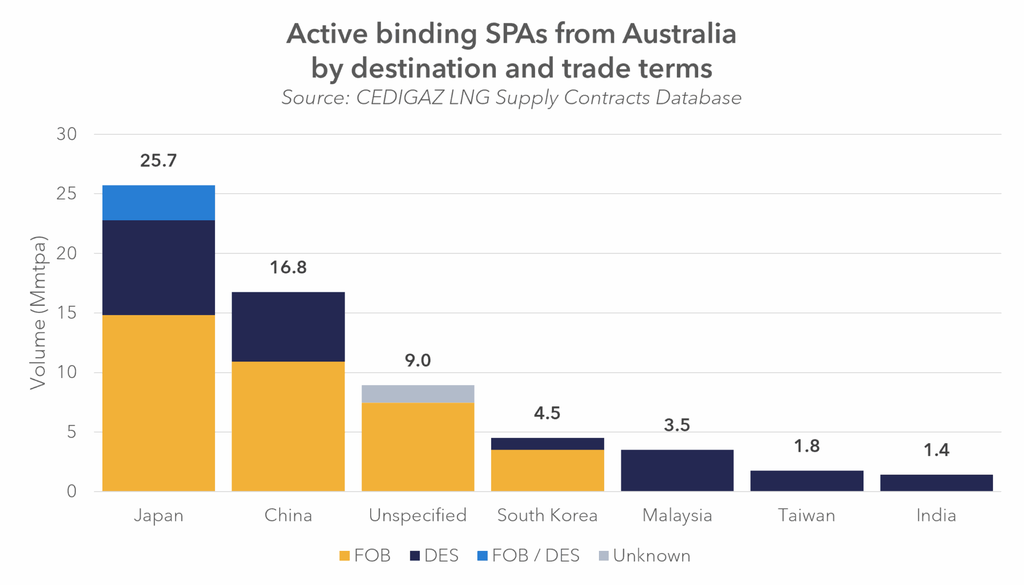
The author also examines Australia’s LNG contract portfolio, showing that Japan remains the largest contracted destination with 25.7 Mtpa, followed by China (16.8 Mtpa), while a significant share of volumes remains contracted to unspecified destinations. Unlike Qatar, Australia’s portfolio is dominated by FOB contracts, giving buyers greater flexibility to redirect cargoes as market conditions change.
Ultimately, the Australian experience extends well beyond one country’s domestic market. It illustrates how mature LNG exporters must balance upstream investment, domestic supply security, operational resilience and long-term customer confidence if they are to remain competitive in an increasingly dynamic global LNG market.
Source: Cedigaz, “What does the Australia case tell us about challenges standing before the LNG industry today?”, published 10 June 2026. The original analysis includes additional charts, data and detailed discussion. Follow the link to read the full article.