
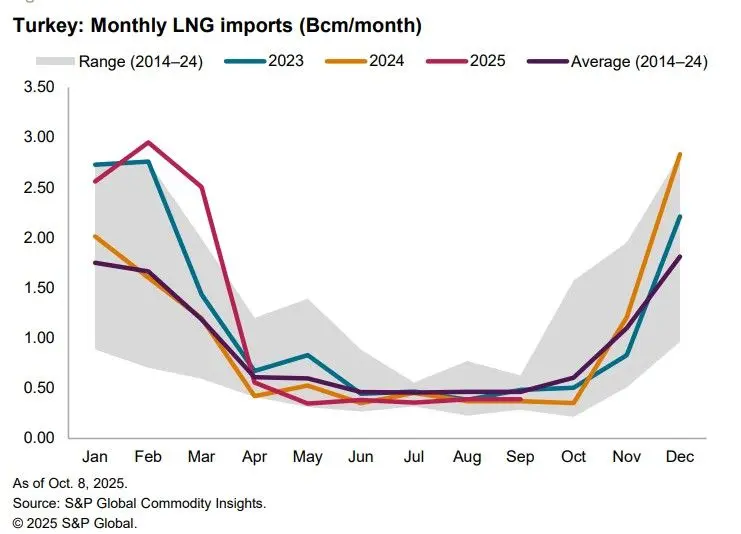
Turkey LNG strategy is entering a decisive phase as state-owned BOTAŞ signs nine new contracts and ramps up domestic production.
Turkey’s flurry of new LNG contracts and the ramp-up of domestic gas production are transforming its supply mix and reducing reliance on Russian and Iranian pipeline imports. The combination of diversified LNG sourcing and growing flexibility positions Ankara to emerge as a key regional gas hub linking Europe and Asia.
Turkey is reshaping its gas supply landscape through an unprecedented wave of LNG contracting and rising domestic production. According to the Oxford Institute for Energy Studies (OIES), state-owned BOTAŞ has signed nine new LNG agreements in 2025—covering up to 20 Bcma—just as major pipeline deals with Russia and Iran approach expiry.
This portfolio, coupled with fast-rising output from the Sakarya offshore field (set to reach 15 Bcma by 2028), will sharply reduce import dependency and enhance Ankara’s leverage in future negotiations.
With nine new LNG contracts, rising domestic output, and waning reliance on Russian and Iranian pipeline gas — Turkey is positioning itself as a flexible, competitive gas hub for Eurasia.
Lucie Roux, S&P Global, notes that Turkish gas demand is set to reach a record 57 Bcm in 2025, with no single supplier providing more than 40% of imports, while Modern Diplomacy suggests Turkey could meet over half of its needs via LNG by 2028.
Together, these shifts position Turkey as an increasingly flexible and competitive gas hub linking European and Asian markets — and a pivotal player in global LNG trade.
Sources: Oxford Institute for Energy Studies (OIES); S&P Global Commodity Insights; Modern Diplomacy