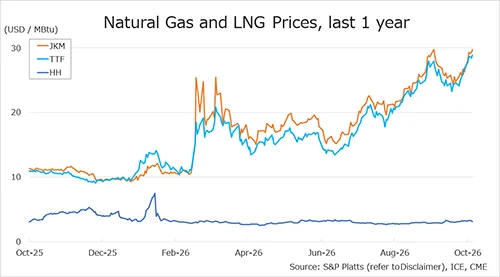
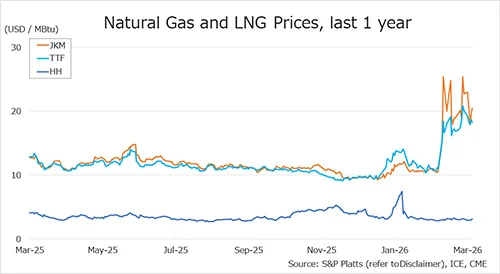
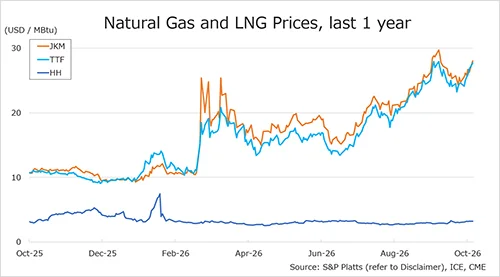
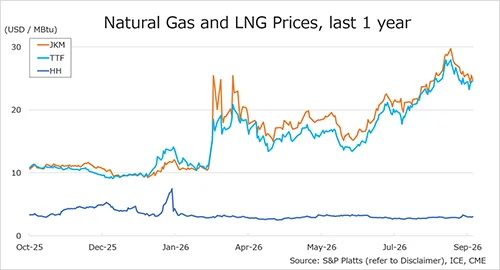
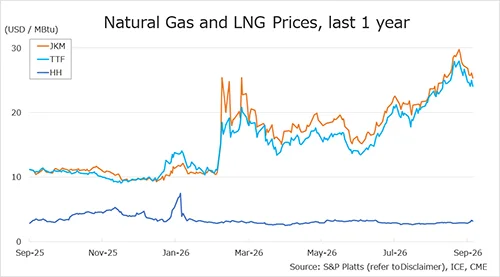
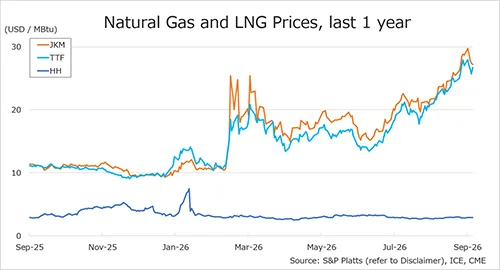
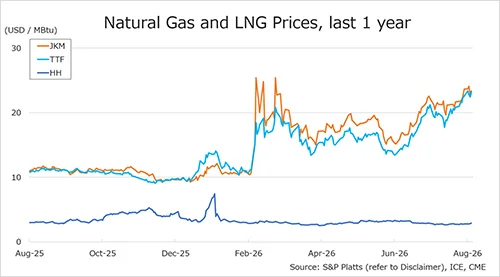
Natural gas prices moved unevenly last week, with JKM showing sharp volatility on Middle East tensions and Australian LNG outages, TTF easing overall on steady supply, and Henry Hub remaining broadly stable. The weekly trend in natural gas prices reflects shifting geopolitical risk, weather expectations, and storage and supply fundamentals across key gas markets.
Asia – JKM
The Northeast Asian assessed spot LNG price JKM (May delivery) for last week (23 – 27 March) rose to USD 20.0/MBtu on 27 March from USD 18.7/MBtu the previous weekend (20 March). At the beginning of the week, JKM rose to high-USD 22s/MBtu on 23 March due to concerns over additional attacks by Iran on Gulf countries after President Trump warned on 21 March of possible attacks on Iran’s power infrastructure.
Prices then declined amid easing geopolitical risks following President Trump’s subsequent announcement to postpone the attack on Iran and sluggish spot demand in Northeast Asia, falling to low-USD 18s/MBtu on 25 March. In the latter half of the week, prices rebounded on fading expectations for stabilization in the Middle East situation and unplanned outages at several LNG production facilities in Australia caused by a cyclone, reaching mid-USD 20s/MBtu on 27 March.
METI announced on 25 March that Japan’s LNG inventories for power generation as of 22 March stood at 2.39 million tonnes, up 0.09 million tonnes from the previous week.
Europe – TTF
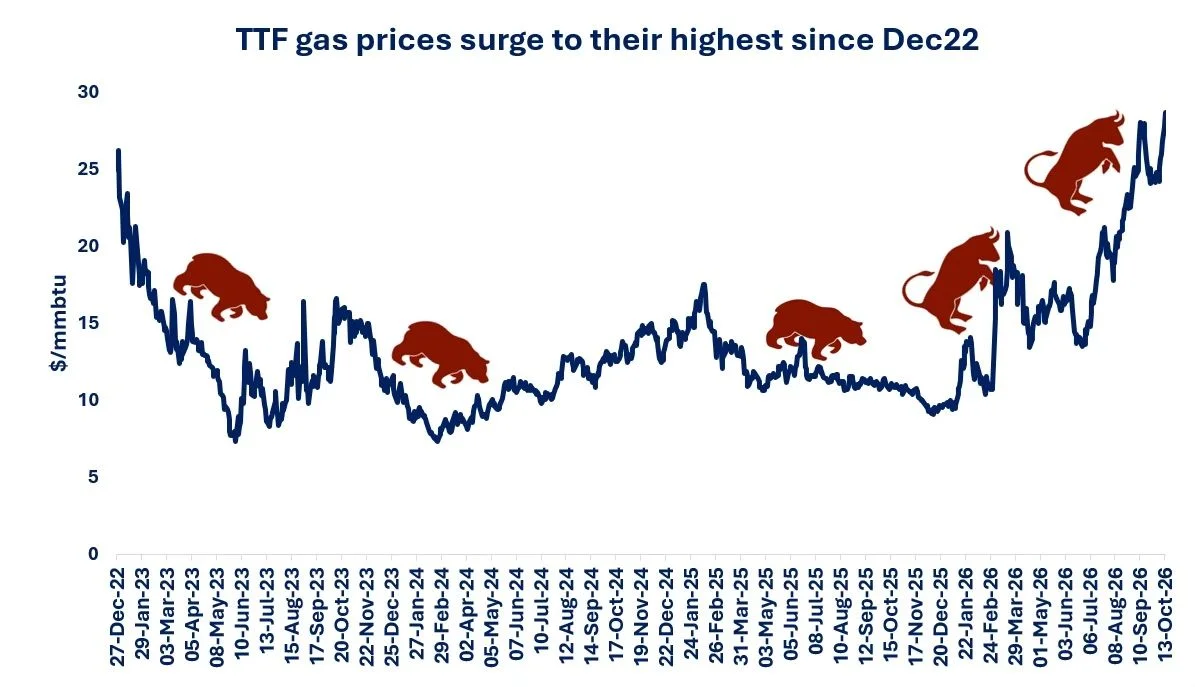
The European gas price TTF (April delivery) for last week (23 – 27 March) fell to USD 18.3/MBtu on 27 March from USD 20.1/MBtu the previous weekend (20 March).
In the first half of the week, TTF continued to decline amid easing geopolitical risks following the announcement that attacks on Iran’s power infrastructure would be postponed for five days and reports of the start of negotiations among relevant countries, as well as increased gas supply from Norway, falling to USD 17.9/MBtu on 25 March. Prices later rose to USD 18.7/MBtu on 26 March due to fading expectations for stabilization in the Middle East and forecasts of lower temperatures and reduced wind power generation in Europe.
However, TTF fell again to USD 18.3/MBtu on 27 March due to steady supply and expectations of a recovery in wind power generation. According to AGSI+, the EU-wide underground gas storage was 28.2% on 27 March, down from 28.5% the previous weekend, down 16.4% from the same period last year, and down 30.5% over the five-year average.
United States – Henry Hub
The U.S. gas price HH (April delivery) for last week (23 – 27 March) remained almost unchanged at USD 3.1/MBtu on 27 March from USD 3.1/MBtu the previous weekend (20 March). At the beginning of the week, HH fell to USD 2.9/MBtu on 23 March due to easing geopolitical risks in the Middle East following the announcement to postpone attacks on Iran’s power infrastructure for five days and reports of continued ceasefire negotiations between the U.S. and Iran.
Although heating demand remained weak due to warm weather, prices subsequently rose amid continued tensions in the Middle East and strong feedgas demand for LNG in the U.S., reaching USD 3.1/MBtu on 27 March. The EIA Weekly Natural Gas Storage Report released on 26 March showed the U.S. natural gas inventories as of 20 March at 1,829 Bcf, down 54 Bcf from the previous week, up 5.2% from the same period last year, and 0.8% increase over the five-year average.
Source: JOGMEC
Updated: 30 March 2026