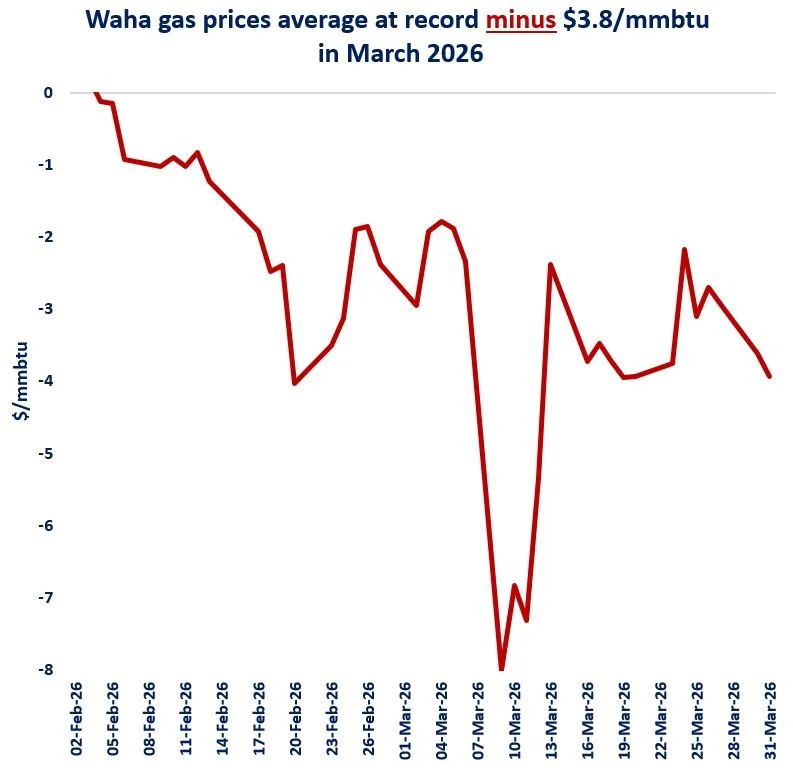
Waha gas prices averaged a record low of minus $3.7/mmbtu in March as the Permian hub continued to suffer from insufficient takeaway capacity.
Gas prices at Waha averaged at a record low of minus $3.7/mmbtu in March, as the most famous Permian hub continues to suffer from insufficient takeaway capacity.
Could you imagine paying one day someone to take your natgas? Hard to think of this when you are in Europe or in Asia, but magic can happen in the Permian.
Natural gas production in the Permian basin grew by more than tenfold since 2009 mainly on the back of associated gas, essentially a byproduct of oil. And while the region’s gas processing and pipeline capacity was expanding at a staggering rate, still not enough to absorb all the gas which is being produced…
This trend continued in March, with Permian gas production surging by 10% yoy to an all-time high of over 20 bcm (slightly above the Basin’s actual pipeline takeaway capacity, meaning that some of the pipes are now running above nameplate).
The limited takeaway capacity pushed Waha prices to a record monthly low of minus $3.7/mmbtu as oil producers were willing to pay others to take their natgas so that they can continue to produce oil…
To put this into context, Henry Hub was trading at a premium of $6.8/mmbtu through March, meaning that with a pipeline of 2 bcf/d you could have made just over $400 million…
New pipeline capacity is set to be commissioned in the second half of the year, with Blackcomb (2.5 bcf/d), Gulf Coast Express (0.5 bcf/d) and Hugh Brinson (1.5 bcf/d) coming into play later in the year and providing some relief to Permian producers…
But until then, Waha prices could see more downward pressure, especially when considering the current oil price environment, which is incentivising more drilling and more production.
Debottlenecking the Permian, including through additional pipeline and gas processing capacity, will be key in the coming years to further enhance the cost-competitiveness of US natgas.
Source: Greg Molnar