Plans for Turkey’s gas hub are gaining momentum, with the country making steady progress as it positions itself as a key LNG and pipeline enabler in the wider region. As Europe reshapes its supply landscape, the Turkey gas hub strategy is supported by expanding LNG capacity, growing transit flows, new trading mechanisms and ongoing market reforms.
Turkey remains one of Europe’s largest gas markets, consuming around 50–55 bcm/year and handling roughly 10% of EU gas imports through transit.
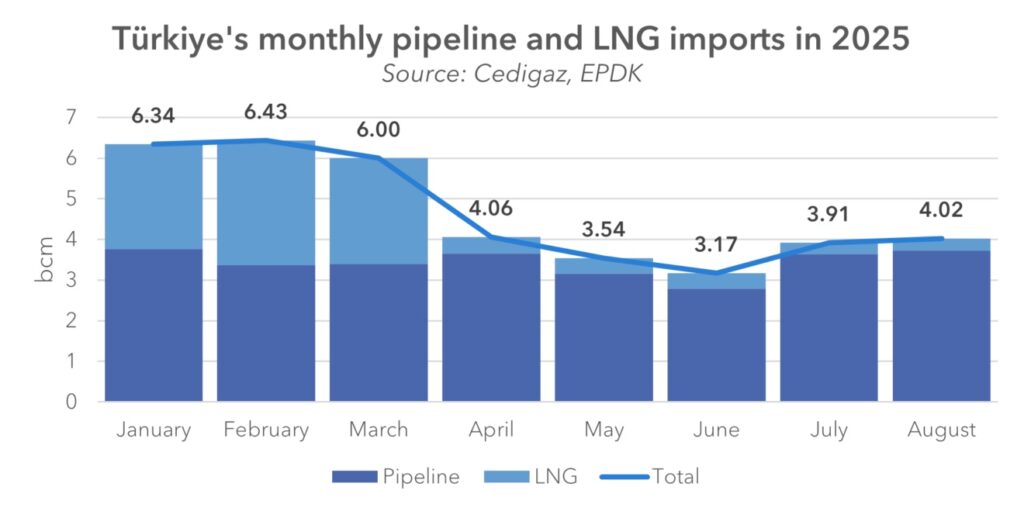
Pipeline deliveries have strengthened, with August 2025 pipeline imports rising about 6% year-on-year to 3.7 bcm, while LNG imports fell more than 20% amid mild weather and competitive pipeline pricing.
Turkey operates five LNG terminals with more than 40 bcm/year regasification capacity, offering flexibility even as utilisation fluctuates.
The country’s hub strategy is progressing, including upgrades to the Thrace network, storage expansion targeting 11 bcm working capacity by 2028, and development of a new benchmark — the Turkey Gas Reference Index (TGREF) — on the Istanbul Energy Exchange (EPIAŞ).
With over 100 bcm of annual transit capacity, Turkey’s geography allows it to balance flows from Russia, the Caspian region, the Eastern Mediterranean and the Middle East into Southeast Europe.
But to shift from a “transit corridor” to a full commercial gas hub, Turkey will need deeper market liberalisation, stronger third-party access and closer alignment with EU transparency and governance standards.
Turkey’s dual strategy of pipelines and LNG provides strategic leverage in Europe’s evolving gas market, but realising its hub ambitions will require further market reform and transparency.